Build Crunch, Seasoning and Balance
The universal enemy of crunchy savory snacks is residual internal water. When you roast nuts, pulses, seeds, or dough pieces, moisture migrates from the core to the exterior. If you coat the snack in oil before the moisture has a route of egress, that oil forms an impermeable hydrophobic barrier. The moisture remains trapped inside the starch matrix, yielding a snack that feels tough, chewy, and stale within two hours.
Achieving a crisp snap requires a two-stage thermal cycle: initial moisture evacuation without oil, followed by high-temperature fat roasting to brown the exterior and adhere seasoning dusts.
The Science of Seasoning Adherence
Why does commercial potato chip seasoning cling evenly to every millimeter while home spices sink to the bottom of the bowl? Commercial spices are micronized into particle diameters under 50 microns. At home, standard kosher salt or ground cumin is too coarse to overcome gravitational shear.
To fix this, toss your salt, dried garlic, and nutritional yeast into a high-speed coffee blade or stone mortar until it becomes a velvet dust. Apply this dust within sixty seconds of your snacks leaving the hot oven, while the surface fats are warm and in a receptive liquid state.
The Alkaline Par-Boil Shortcut
When roasting dried or canned beans (chickpeas, fava beans, edamame), simmer them for 3 minutes in water with 1/2 teaspoon of baking soda (sodium bicarbonate). The high pH breaks down surface pectin walls, creating thousands of micro-fissures. When roasted at 200°C (390°F), these fissures burst into blistering micro-shards.
Tested Savory Snacking Formulations
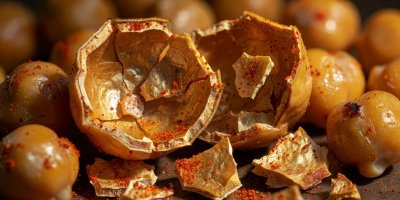
Smoked Paprika & Sumac Garbanzo Crunch
Method: Rinse 400g cooked chickpeas. Dry between clean linen towels until hulls slip easily. Par-bake at 170°C for 22 minutes completely dry. Toss with 12ml high-oleic sunflower oil and your micronized paprika-sumac dust. Return to oven at 200°C for 8 minutes.
Brown Butter & Rosemary Toasted Walnuts
Method: Par-boil 200g raw walnut halves in salted water for 60 seconds to purge bitter tannins. Drain dry. Roast at 160°C for 12 minutes. Glaze with 20g foaming browned butter infused with minced rosemary and cracked black pepper. Spread flat on parchment to cool.
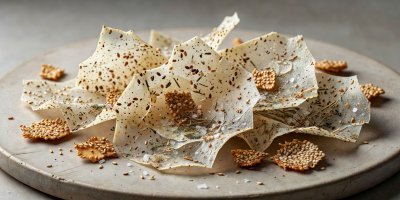
Crisp Nori Rice Sheet Chips
Method: Brush circular rice paper sheets with cold tamari water. Layer with toasted nori sheets. Cut into triangles with scissors. Flash fry in 180°C neutral peanut oil for 4 seconds; watch them puff instantaneously into white, ultra-light crisps.
Cause: Oven temperature exceeded 175°C during the initial roasting phase. Tree nuts carry high polyunsaturated fats that combust rapidly. Drop temperature to 150°C and extend bake time.
Cause: Snacks were bottled before reaching ambient room temperature (21°C). Residual internal steam condensed on container walls and re-hydrated the starch.