Bake a Smaller Batch With Confidence
Most home bakers who attempt to quarter a standard recipe end up with dry, spongy, or rock-hard pastries. The reason is elementary geometry: the square-cube law. When you bake a miniature 4-inch skillet brownie or two drop cookies, the surface-area-to-mass ratio multiplies dramatically. Heat strikes every gram of batter with three times more intensity, evaporating free water before internal starch granules have enough time to swell and set.
To conquer small-batch baking, you cannot simply perform arithmetic division on an 8-portion cake formula. You must deliberately manipulate your hydration sources and dial in exact lipid-to-flour boundaries.
Solving the Whole Egg Dilemma
A standard large egg weighs approximately 50 grams (32g white, 18g yolk). If you divide a formula by four, you are tasked with adding 12.5 grams of egg. Whisking an egg and measuring grams with a digital scale is functional, but what does that 12.5 grams actually do to a miniature dough?
Egg whites are 88% water and 10% albumin protein. In small bakes, excess egg white turns doughs spongy and bread-like. For high-fat treats like cookies, blondies, and crumb bars, ditching the white and using exclusively one half of a rich yolk (or one full egg yolk with zero whites) creates supreme fudginess without cakey dryness.
Vessel Thermal Mass Dictates the Crumb
Avoid thin dark non-stick muffin tins when baking miniature portions. Dark metal absorbs radiant heat too fast, scorching outer edges in 9 minutes while the core remains raw batter. Use heavy stoneware ramekins or heavy 5-inch cast iron skillets that distribute heat steadily across the entire base.
Small-Scale Formulas for Immediate Kitchen Testing
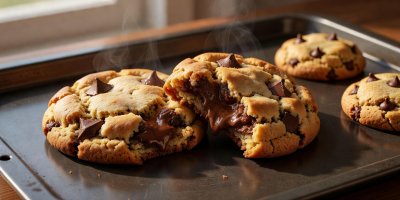
Dual 85g Browned Butter Chunk Cookies
Method: Brown 35g unsalted butter until amber specks drop. Whisk with 30g dark brown sugar and 15g cane sugar. Whisk in 1 single egg yolk (18g) and 2g vanilla. Fold in 55g all-purpose flour, 1g baking soda, and 45g chopped 65% dark chocolate. Bake at 180°C for exactly 10 minutes.
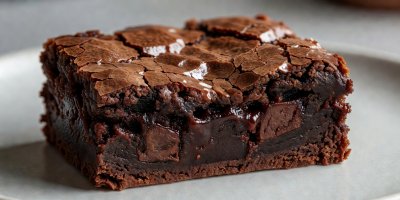
Mini Dutch Cocoa Skillet Brownie
Method: Melt 45g butter with 50g dark sugar and 20g dutch-process cocoa powder over low heat until glossy. Stir in 1 egg yolk and 15ml heavy cream. Fold in 25g flour and 1g salt. Pour into 5-inch buttered skillet. Bake at 175°C for 14 minutes. Do not insert a toothpick into the center.
Single-Ramekin Molten Berry Crisp
Method: Toss 120g frozen blackberries with 8g cornstarch and 10g sugar in a ceramic ramekin. Crumble 20g rolled oats, 15g cold cubed butter, 10g flour, and 10g brown sugar between fingers until peas form. Layer over fruit. Bake at 190°C for 18 minutes until purple juices bubble violently.
Cause: You substituted a whole egg instead of a single yolk, or you baked past the 14-minute mark. Egg white moisture activated excess gluten proteins.
Cause: Melted butter was mixed while still hot (above 50°C), dissolving sugar crystals before flour could bind the fat. Cool browned butter to lukewarm room temperature before creaming.